


Personal Data Protection Starts with Everyday Practice! MCUT Invites Information Security Expert to Address Common Campus Risks and Incident Response

As university administration becomes increasingly digitized and cloud services more widely adopted, personal data are being collected, transmitted, and stored more frequently than ever. Protecting personal data has therefore become an essential part of the daily responsibilities of every faculty and staff member.
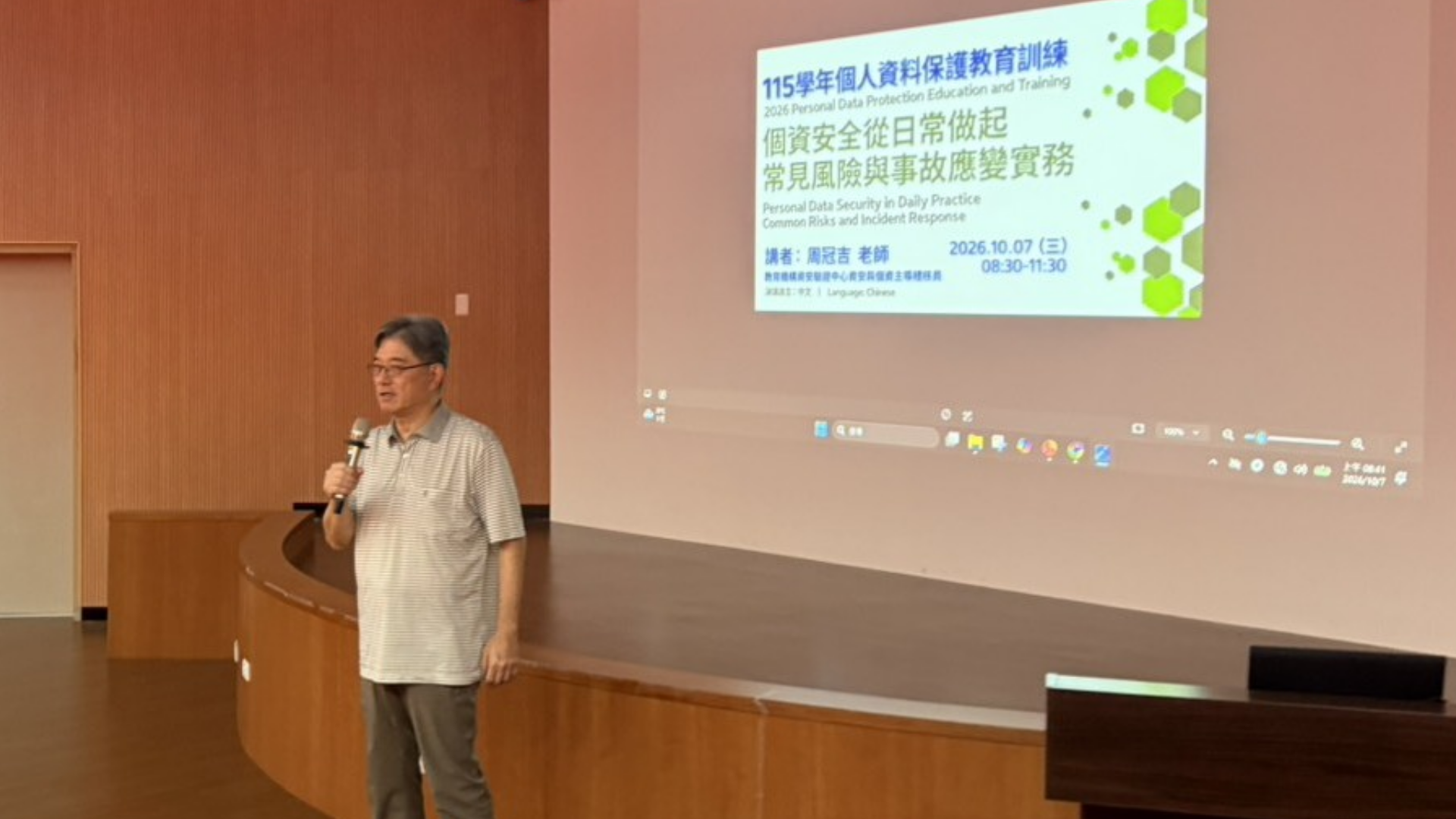
To help university personnel better understand key data protection practices and reduce the risk of data breaches, the Library of the Office of Library and Information Services at Ming Chi University of Technology held the 2026 Personal Data Protection Training, titled “Personal Data Protection Starts with Everyday Practice: Common Risks and Practical Incident Response,” on the morning of Wednesday, October 7, 2026, at the lecture hall on the first floor of the Library and Information Building. The session was led by Mr. Kuan-Chi Chou, a lead auditor for information security and personal data protection at the Information Security Certification Body for Educational Institutions. Vice President Cherng-Min Ma, Secretary General Chin-Wan Chou, and Dean of Library and Information Services Yi-Nan Lin attended the event, along with faculty and staff members from across the University, bringing the total attendance to 154.
At the opening of the event, University administrators emphasized that protecting personal data is a shared responsibility and an integral part of university operations. Faculty and staff were encouraged to exercise greater care when handling personal information, promptly report any irregularities, and consult the Office of Library and Information Services whenever questions arise, working together to safeguard personal data across campus.
Focusing on Taiwan’s Personal Data Protection Act and its application to everyday campus operations, the session began by introducing the basic concepts of personal data and sensitive personal data. A key point was that whether information constitutes personal data depends on its ability to identify a specific individual, rather than on whether the information is confidential. Even publicly available information may still be considered personal data if it can identify an individual on its own or when combined with other information.
The session also covered the principles governing the collection, processing, and use of personal data, as well as the rights of data subjects. Faculty and staff were reminded that appropriate safeguards should be applied throughout the entire data lifecycle, from collection and use to storage and disposal. Even when services involving personal data are outsourced to external vendors, the University retains responsibility for appropriate oversight and management.
To make potential risks easier to recognize, the training drew on common scenarios encountered in campus operations. Examples included sending group emails without using the Bcc field, leaving outdated personal information in hidden Excel worksheets, reusing documents containing personal data as scrap paper, and failing to promptly deactivate accounts after employees leave the University. Each of these seemingly minor oversights can result in unintended data exposure.
In response to these risks, the session introduced practical safeguards in four areas: data transmission, physical protection, data sharing, and system access permissions. Participants were also reminded that, in the event of a personal data incident, it is essential to report the incident immediately, preserve relevant information and evidence, and initiate the required response and reporting procedures.
The session concluded with three practical principles for everyday work: collect personal data only when necessary and use it only for the purposes originally specified; safeguard data at every stage, from storage and transmission to deletion; and, when in doubt, confirm before taking action.
Through this training, faculty and staff gained a more comprehensive understanding of how personal data protection applies to their daily work, from legal requirements and real-world scenarios to incident response. By putting sound data-handling practices into action in everyday operations, the University community can work together to reduce the risk of data breaches and foster a safer, more trustworthy campus information environment.
Image (No. 1) Description: Vice President Cherng-Min Ma of Ming Chi University of Technology delivering opening remarks at the training session, encouraging colleagues to value personal data protection and apply it in their daily work.
Image (No. 2) Description: Mr. Kuan-Chi Chou, lead auditor specializing in information security and personal data protection at the Information Security Certification Body for Educational Institutions, delivering a lecture on practical approaches to personal data protection in daily operations and incident response.
