


From a Jar of Honey to a Postcard: MCUT USR Students Explore Beekeeping, Green Supply Chains and Bee Ecology in Sanzhi

Ming Chi University of Technology’s 2026 Ministry of Education University Social Responsibility (USR) Project, “New Taipei Industry ESG Practices: Greener and Better,” organized a beekeeping industry visit and postcard art workshop at Mu Feng Farm in Sanzhi on September 12. Led by Assistant Professor Li Shu-Hua of the Department of Business and Management, the event brought together students from the Departments of Business and Management and Visual Communication Design. Assistant Professor Nguyen Thi Kim Anh of the Department of Safety, Health and Environmental Engineering was also invited to participate in interdisciplinary knowledge exchange.
During the event, farm founder Chien Te-Yuan and farm manager Lee Hsin-Jui shared their practical beekeeping experience and knowledge of honey products. Instructor Pei Jo-An guided students in creating watercolor postcards, while Assistant Professor Li Shu-Hua further helped students understand the connections among local industries, green supply chains, and ecological sustainability.
From Hive Management to Floral Resources: Understanding Sustainability Challenges in Local Beekeeping
Drawing on his practical experience, farm founder Chien Te-Yuan introduced the origins, harvesting seasons, and varieties of honey, explaining the process from nectar collection and hive management to honey harvesting and product distribution. He noted that beekeepers generally move hives at night, when bees are less active, to reduce colony losses and operational risks. Because bees are highly sensitive to environmental changes, colony health can also be affected by diseases and external environmental conditions, making continuous monitoring and timely adjustments to management practices essential. Chien also explained the distinct roles of worker bees, drones, and queen bees within a colony. He highlighted how flowering seasons, climate conditions, and the distribution of nectar-producing plants influence honey varieties and yields. Through these practical insights, students gained a better understanding of local beekeeping production conditions and how the natural environment affects honey production and supply stability.
From Honey Tasting to Supply Chain Analysis: Understanding How Product Value Is Created
Approaching the topic from a consumer perspective, farm manager Lee Hsin-Jui guided students in preparing honey water and observing differences in the appearance, clarity, and sedimentation of various honeys. She emphasized that honey quality should not be judged by appearance alone and encouraged consumers to check product labels and source information before making purchasing decisions. Students also tasted different varieties of honey and explored the complex flavors of forest honey, which results from bees collecting nectar from multiple plant species.
From a business management perspective, Assistant Professor Li Shu-Hua used a jar of honey as a starting point to help students map the supply chain, including floral resources, hive management, harvesting and processing, product labeling, and sales. Students examined how product value is created at each stage of the supply chain and discussed how ecological changes can affect production and supply stability. By combining product experiences with supply chain analysis, the activity helped students connect consumer perspectives with production processes and deepen their understanding of local industry operations and green supply chains.
Combining Bee Ecology and Watercolor Art: Expressing Environmental Observations Through Art
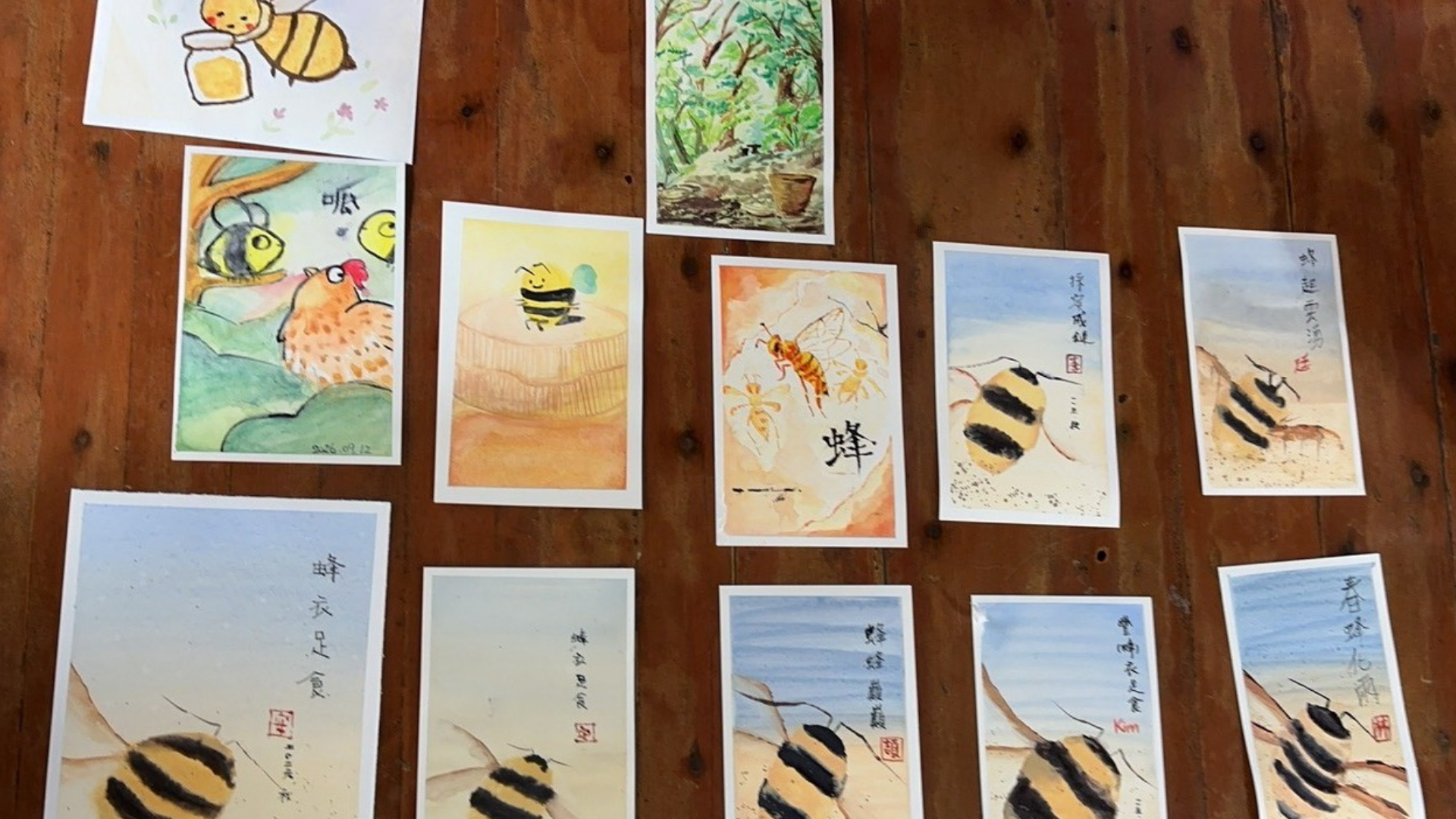
Led by instructor Pei Jo-An, the postcard art workshop incorporated knowledge of bee ecology gained through prior consultations with beekeeping professionals. Students were guided to observe bees’ physical characteristics, activities, and surrounding environments, then express their observations through color, line, and brushwork. Pei demonstrated how different color values and subdued tones could establish an environmental atmosphere, and how watercolor techniques could convey the fuzzy texture of bees. Students were encouraged to move beyond realistic representation and develop their own creative interpretations based on personal observations and impressions.
The workshop also incorporated natural materials, such as twigs, for writing and signatures, bringing elements of nature into artistic expression. Through the creative process, students translated knowledge gained from the industry visit into visual representations while learning about the importance of bee pollination to agricultural production and biodiversity. The experience also encouraged reflection on the relationship between human activities and natural ecosystems.
Connecting Industry and Ecology Through Interdisciplinary Practice: Advancing University Social Responsibility
This activity integrated practical beekeeping knowledge, business management analysis, and art and design, encouraging students to explore local industries from multiple perspectives, including production, consumption, and design. It also highlighted the importance of balancing product quality, market demand, and ecological considerations in sustainable business practices.
Looking ahead, the project will continue to strengthen collaboration with local industries and encourage students to apply their learning to product packaging and green supply chain design. These efforts support the United Nations Sustainable Development Goals (SDGs), particularly Goal 9, “Industry, Innovation and Infrastructure,” and Goal 15, “Life on Land.” Through interdisciplinary learning and practical engagement, the project aims to advance the university’s social responsibility.
Image (No. 1) Description: Group photo at Sanzhi Mu-Feng Beekeeping Farm.
Image (No. 2) Description: Bee-themed watercolor postcards completed by students.
